Thursday, February 7, 2008
The Hump Continues...
I just happened to mention to a friend about my entry on the word "hump" and its French equivalent. Shockingly, she had heard the expression before! (And to my dismay she had not grown up on a camel farm in North Dakota but in the English countryside.) In fact, when someone's "got the hump" it means they're sulking. Apparently it's reserved for adults who take on behavior worthy of a toddler throwing a temper tantrum. I don't think I could ever use this expression seriously but I do think I can begin to trust my dictionary once again.


Thursday, January 17, 2008
What You Got the Hump About?
So last night I asked my husband what "hump" was in French. (Don't ask why.) And I didn't mean "hump" as in a Quasimodo-like hump but hump as in "to hump," like what a dog might do to your leg at a dinner party. Here's what I found in Harrap's, a mammoth of a dictionary that I consult nearly every day.
être bossu: to have a hump
le plus difficile est passé maintenant: we're over the hump now
faire la tête, bouder: to have the hump, be sulking. (What????? To have the hump?)
pourquoi est-ce qu'il fait la tête?: what's he got the hump about? Say what!!
Needless to say, I burst out laughing at this one. Never ever have I heard the expression "What's he got the hump about?" and if someone has I'd be inclined to think he/she had grown up on a camel farm in North Dakota. I don't know if this is just bad translation or something that simply can't be translated -- a direct translation, which also wouldn't make any sense, is "why's he making the head?" -- but I can't stop laughing at the thought of saying this to someone in English. In looking for another word I landed on "couch-potato." If you ever want to talk about someone who's a real couch-potato go ahead and say it in French, "il est très télé." Right. He's really television that guy. A real big lazy television.
Then again, to poke fun at English, why potato and not turnip?
Monday, January 14, 2008
Uh...gross.

Every couple of months there's a city-wide advertising campaign to try and convince, remind, teach, and scold the Marseillais a thing or two about a particularly odious French problem: caca. More specifically, dog caca. This is the latest ad. I'm not sure it's effective but it certainly catches one's attention...hopefully not during lunch hour!
Friday, January 11, 2008
Not Sold on Les Soldes
Let it be known I don't really like shopping. Occassionally I'm inspired to hit the racks but usually I shop when I need something. Like boots. Boots are everywhere in France. No matter your age almost every female, even the least fashion-conscious, owns a pair of boots. The realization that I didn't have a pair of flat-soled, stylish yet comfortable boots irked me; all of a sudden my wardrobe was conspiring against me to make me feel even more un-French. So a few months ago I began the hunt for a pair of boots. But there were so many styles and colors, let alone stores, that I froze, indecisive and uncertain, when confronted with a decent or above-average pair. It was either the wrong height (ie the type of boot that looks like it walked off the set of "The Three Musketeers"), the heel was either too pointy or tall, the color wasn't just right, or it was too expensive. Or even too cheap, which meant it would fall apart in a week's time with all the walking I do. Then I remembered les soldes -- the sales -- and decided to wait a little longer to find the perfect boot. By law, for nearly two weeks, all stores must offer their latest collections (summer for the July sales and winter for the January sales) at incredible discounts. I recently learned that the reason stores don't have sales throughout the year (as is the case in the U.S. and most other parts of the world) is to prevent the bigger names, like Galeries Lafayette, from putting the smaller businesses out of business. Such is the theory of a socialist system. I see the point, but I find it somewhat protectionist. Of course, laws are needed and do exist to protect small businesses but enacting a law that discourages and prevents owners and consumers from doing what they do best (selling and buying) when they want to, would never happen in the U.S. Perhaps that's because we're such a money-driven society...In any case, the days preceding the sales are buzzing with anticipation. The racks overflow, colored tags appear next to the original price tag (although you don't find out its equivalent discount price until the first day of the sale), posters go up on storefront windows (PRIX CHOC, LIQUIDATION TOTALE, SOLDES! SOLDES!), and, most noticeably, tons of women are to be seen carousing the racks -- but not buying anything. They're scouting things out, misplacing and hiding items, trying to convince the salesperson to put things aside or to give them the discount in advance, both of which are not allowed. I even saw entire sections of stores being cordoned off to seperate the non-sale items from the sale ones and bins full of purses being saran-wrapped to prevent impatient fingers from doing all or any of the above. There's quite a bit of preparation involved. And so guess what this self-confessed non-shopper did on the first day of the sales? Woke up at 7 am, took the metro to the center, and hit the stores by 8. I was determined to get those boots I had seen the day before. (Yes, I confess, I followed the advice of one of Marc's female colleagues and did a pre-shopping.) I knew things went fast and that my size, 38, would also go by fast. Every woman on the metro was potential competition; I laughed at myself, getting hyped up for a stupid sale, but it was also exciting. I wanted to be one of the first. I wanted to get that pull with the scoop neck because, dammit, there were only 3 left and of those 3 only 2 mediums! In the end, I got the boots and the pull. Yet it was so anti-climatic and I felt like such a...consumer. I went to a few other stores but nothing caught me eye. Nothing on sale was that great, none of the discounts that amazing (although I'm sure in some stores incredible deals can be had), and I never witnessed any women fighting or playing tug-of-war with some stupid clothing, as I've heard sometimes happens. All in all, les soldes was rather disappointing. Maybe it depends on the year, or on the enthusiasm of the shopper, but I can't really complain because I finally have my first pair of French boots.
Tuesday, January 8, 2008
Verlan: Word Play for Les Francais
At some point I realized that if I were going to truly learn French I had to drop the negative, smarmy, and holier-than-thou attitude. On particularly tough, depressing days I take out my frustrations on French culture and language. I poke fun at its hoity-toity rhythms, lambaste its delicate pronunciations, decry its lip-numbing (literally) formations and self-indulgent flowery-isms (who needs poetry in English when you have the suffix –ism?), and, most irritatingly, its play on words or jeux de mots. The French LOVE word play. My husband Marc has always told me about this, a phenomenon that had crossed the Atlantic and become an integral part of Quebecois culture as well. Word play isn’t just for the average cornball. In France it’s considered intellectual, as common as an octogenarian reading a bande desinée or comic book, and funny. Much of French humor is tied to word play because 1) there are so many words that sound alike and 2) so many of those same words that contain several, extremely unrelated meanings. The possibilities are endless. And so I shouldn’t have been surprised to learn about Verlan. Verlan is a language within a language. I can’t help but think of Ebonics as the near-perfect analogy. Both originated in the suburbs (meaning outlying city areas as opposed to strictly ghettoes), both were propagated by the hip hop community, and both have become accepted – to a certain degree – in every day life and interactions. Verlan began in Paris in the 1930s, gained momentum in the 70s and then saw an explosion in the 90s when French rap began to take off and reach a wider audience. (Here’s the departing point in my comparison, as Ebonics is generally used by the African-American population and Verlan is used by the populace at large.) Now Verlan is fashionable – it is a verb, verlaniser, much like “google” – although some already consider it ringard (corny, old-fashioned) and even d’une mauvaise manière (of a poor manner). Each to his own. But Verlan is a curiously interesting function of modern language-users; we continually attempt to make language less complex and more accessible by reducing syllables, dropping and/or rearranging letters, and inverting entire words. I find the opposite to be true, and it makes me wonder, somewhat nervously, what language(s) will be like 100 years from now, even earlier…which brings to mind David Mitchell’s “Cloud Atlas,” when in a futuristic world brand names become verbs and nouns. Nonetheless, one of the first mot verlanisé that I came across – without knowing it at the time – was keuf. Keuf means flic, or “cop,” in French. And keuf is flic, à la verlan. I mean, can’t you tell?! Here’s how that one works: keuf (keu-fli) = "flic" (fli-keu). In a way it works like Pig Latin: by dropping the final consonant sound “c” (as in “cut”) and adding the vowel sound –eu, the word thereby loses its original vowel sound to become “keu.” Add the “f” and voila!, you have the verlanised word keuf. But this is only what generally happens with a monosyllabic word. The rules are different for words of two syllables (apparently the simplest form) and for those with three or more. It must be known, however, that Verlan is intended to be a personalized language so although there are some “rules” none are set in stone. Here are a few more examples just to rattle your brain a bit:
zarbi = "bizarre"
zyva = "vas-y" (go ahead)
Moi → ouam
Toi → ouat
Méchant → chanmé (mean)
Gentil → tigen (nice)
Métro → tromé ou trom
Voiture → turvoi (car)
So far, les mots verlanisés haven’t held much appeal for me, perhaps because I’m still plowing through vernacular French. Then again, if and when the time comes that I do use Verlan I think it’ll be a huge sign that I’ve become more French than I would have ever imagined…et ca sera zarbi!
Wednesday, December 12, 2007
The Cloud


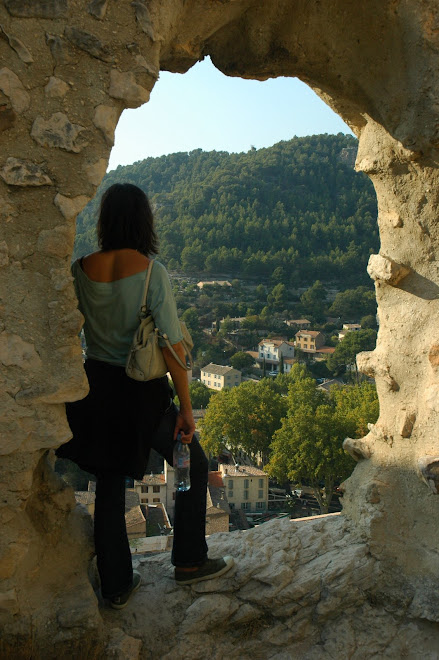
What I enjoyed more this past weekend than tasting the wines of the southern Rhone Valley region was standing on the highest point in the village of Chateauneuf-du-Pape, at the ruins of the old chateau, surveying the countryside that unfurled before me like a perfectly woven tapestry. It was magical. When we reached the hilltop it was windier, and slightly colder, but the skies were blue and in the distance long, thick clouds rolled in. The darkened tip of Mt. Ventoux was visible and before it, nestled in the crooks of small valleys painted in rusty reds, oranges, and deep greens, were clusters of homes with burning fireplaces. The air was crisp and smelled like baking bread, wood, and clean linen. Gunshots fired. Church bells tolled, first in Chateauneuf-du-Pape and then in the neighbouring village whose church spire I could just make out. Gunshots fired again, this time followed by a chorus of hounds; it was unclear from which thicket of forest the sounds echoed. I walked around the grounds while Marc took pictures. We were alone. And then, in a matter of seconds, the sky darkened and I found myself enveloped in a cloud; nothing in the valley was visible, not even what lay twenty feet ahead. The cloud had muffled the voices of Nature. The absolute silence that ensued was spooky, yet utterly beautiful. What sun remained shone through the chateau windows so that each appeared like a portal, a representation of one moment in time, or several condensed moments, that had ripped open after decades of a comatose-like existence. I stood still. Just as quickly as it appeared the cloud disappeared. Everything became clearer, and louder, and more brilliant than before, the cloud having deposited another layer of dew on the tiled rooftops and pointed treetops. I wanted to stay up there longer to revel in the purity of solitude, of time lost and gained, of past lives...but there was wine to taste and, just as we began the hike down, a car pulled up. My moment was over, as fickle and ephemeral as the cloud itself.
Tuesday, December 4, 2007
Jazz and...Racism?
Every Monday night at a local institution, Le Petit Nice, "jazz et boeuf" starts at 9 and continues until midnight. There's nothing overtly special about the place; its decoration is an odd collection of random memoribilia of the owner's, which can be summed up as nautically musical or musically nautical (old jazz posters, in English, sharing wall space with corroded anchors for example). Its chipped marbletop tables, wooden chairs, and red leather two-seaters, all arranged in an appropriately haphazard fashion, give the joint a neglected but laidback atmosphere. And it's for those reasons that I go there fairly often, whether for a coffee in the afternoon or a glass of white wine in the evening: the people are as mixed and interesting as the decor. There are rastafarians, musicians from the conservatory next door, stoners, office workers, writers, outdoor enthusiasts...yet all these (surface) differences are swallowed by thick clouds of smoke, as permanent as the place itself. At least this was my impression until last night. Let me first say that it seems to be very common, in France, for men of any age to offer a drink to a woman of any age before they've had a proper conversation. In fact, the proposal of a drink is a precursor to any sort of social interaction and/or intention. To not accept the drink is an insult, and depending on the personality and brains of the man a range of responses will follow: disbelief, chagrin, nonchalance, inflamed ego, claims of racism. Yes, you read correctly. I much prefferred the previous Monday night's Mr. Love Pepper (a man from Burkina Faso who was starting an organic aprohidisiac online company) to last night's man from Algeria who drove me and a friend away after 10 long, uncomfortable minutes. Apparently in his lexicon "no" means "yes" and vice a versa. What he, or his ego, didn't understand was that our refusals were not to be taken personal. Rather, it was the desire to listen to music, to talk to one another about girly things, to not be hassled, to not accept a drink that would then oblige us to continue talking, to enjoy the evening without being reminded that we were unaccompanied women, and on and on. Not long after we moved to another table, a woman who had until then ignored the fact that her male companions were chatting to us, approached us with a false air of congeniality and began to ask us a series of questions: Is it because we're Arab that you moved? Is it because of our origins? Was it when he told you his name (Khalid)? I could hear the tension in her voice, and so when she confessed to be "mal a l'aise," or "at unease," I wasn't surprised. I was shocked, however. Was this lady as blind as her friends? Didn't she understand, from one woman to another, what was going on? How could she not take into consideration the fact that we were foreigners, and therefore people who could understand what it's like to be seen as "different" or "other?" We assured her that, no, we were not racists. We were simply two friends who wanted to talk and to listen to music. She left, but not without throwing us a weary, mistrustful glance. I was obviously bothered by the whole thing, and didn't feel comfortable until they left a little bit later. The music played on, we turned down other offers; it was slowly forgotten. But rather than do what Khalid did and take it personally, I tried to view what happened objectively. The conclusion I reached was that I had witnessed what most foreigners, whether as tourists or expats, wouldn't normally witness: the racism that does exist in Marseille, the current tensions between the Arab, or specifically Maghrebian, and French communities, and the "unease" that seems to be reaching boiling point. Khalid and his crew were people who have probably experienced racism, real and imagined, and who have become increasingly aware of themselves and how others view them. It's sad. It's sad that racism exists but it's also sad that ordinary situations take on a murky, layered veneer, that even in the midst of music, laughter, and comraderie -- when labels should be stripped and problems forgotten -- one can feel so unprotected, so vulnerable. On second thought, maybe Mr. Love Pepper wasn't so bad after all.
Subscribe to:
Posts (Atom)